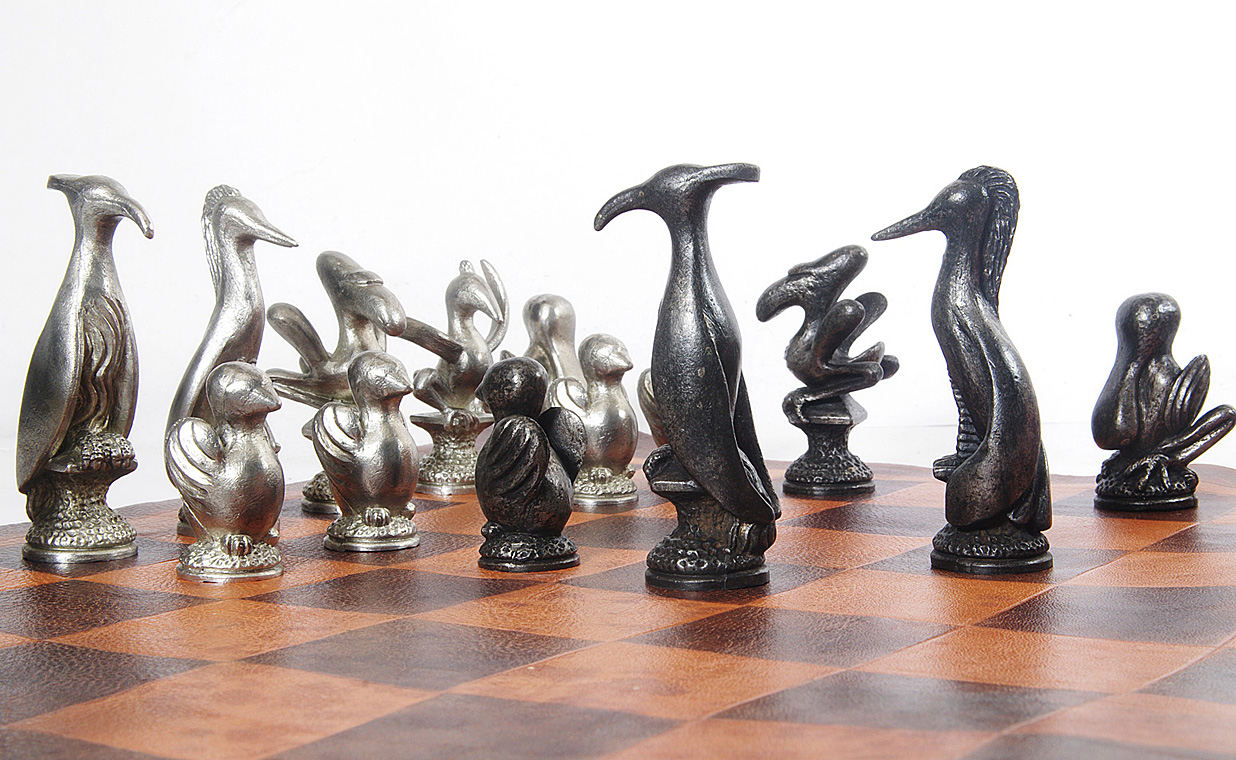
I made a chess set of surreal birds in 1994 while living in Bologna, Italy. The original pieces were modelled in a hard wax and then cast in pewter using flexible rubber moulds. I cast two sets, one to be given as a gift and the second for myself. It took some 26 years before I found the time to fettle and polish the second set, which occurred during the lockdown phase of the Covid pandemic.
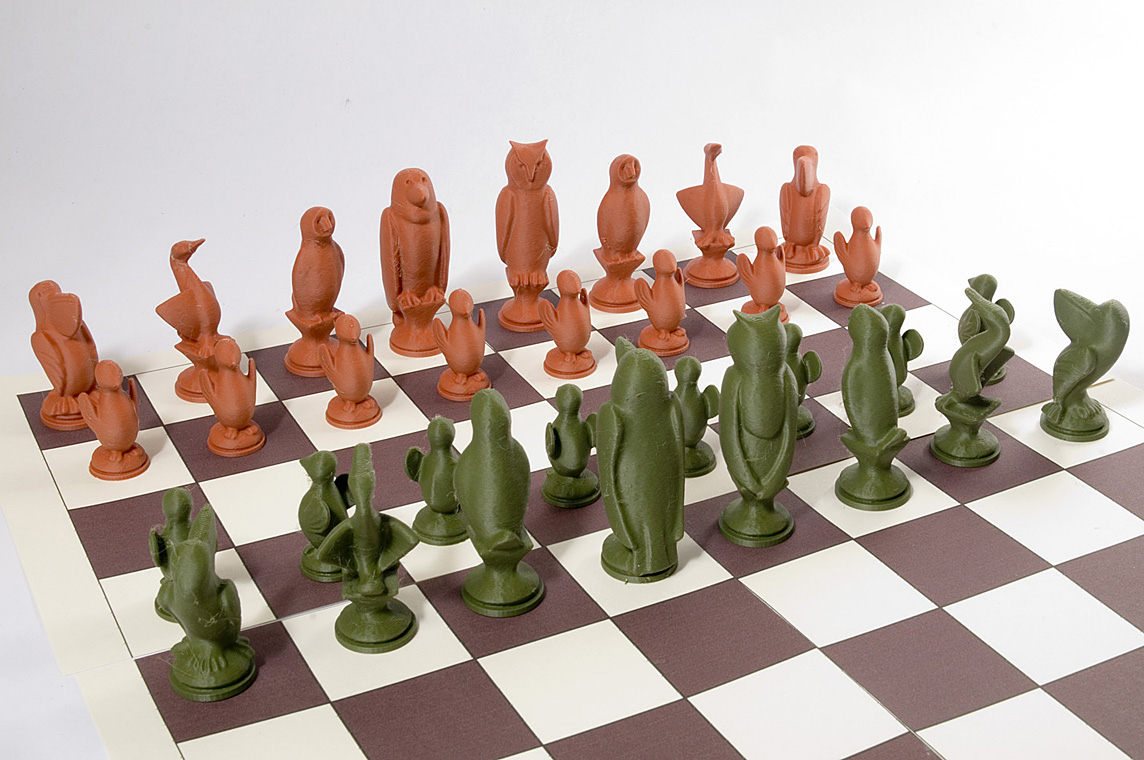
I spent time on other sculptural work, mostly art medals, but rather than casting pewter at home I changed tack by having work cast in bronze by specialist foundries. This eventually became too expensive, but in the meantime 3D printing was becoming cheaper. 3D scanning was also becoming accessible so it seemed a good idea to leave casting aside for the moment. You cannot scan tiny pieces successfully with a consumer level scanner, so for the new chess set I used Chavant modelling clay to fashion larger pieces that would then be reduced in size for printing. While many 3D prints have a honeycomb interior structure for lightness, the chess pieces are printed solid to ensure stability.
Once again I used birds as a source of inspiration for each piece. These new birds, though, would not be 'surreal' like the first set but 'hypothetical' instead. I began the hypothetical birds in 2026 with one very important design difference. When casting in moulds it is vital to avoid undercuts in the design, that is, any detail that might become locked in the mould by its shape. Undercuts can be avoided by using multipart moulds, but this method adds considerably to the time and cost. With 3D printing undercuts are not an issue, but overhangs are, and these must be avoided just as rigorously.
Where chess pieces are designed to be different from a standard set the proportions should be recognisable even if the character of a piece is not, proportions being like the intervals in music, no matter the key. The common Staunton design follows such rules and the recommended proportions are valid from miniature to outsize pieces.
The Pawn
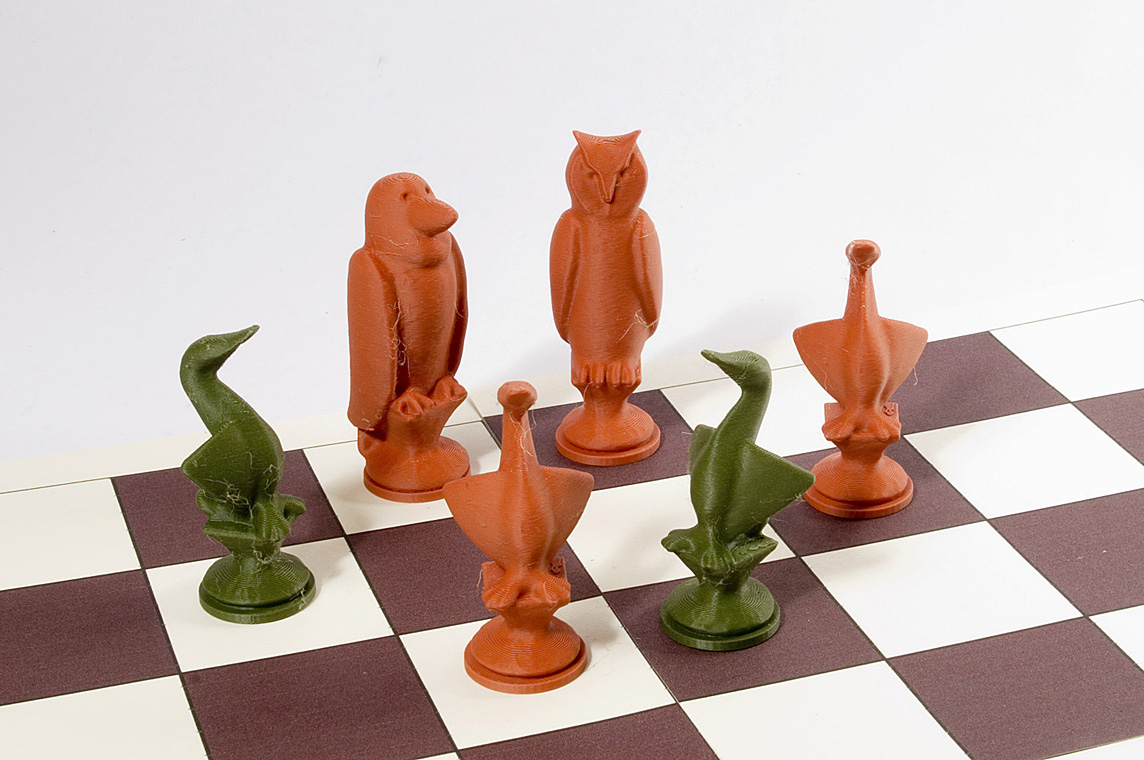
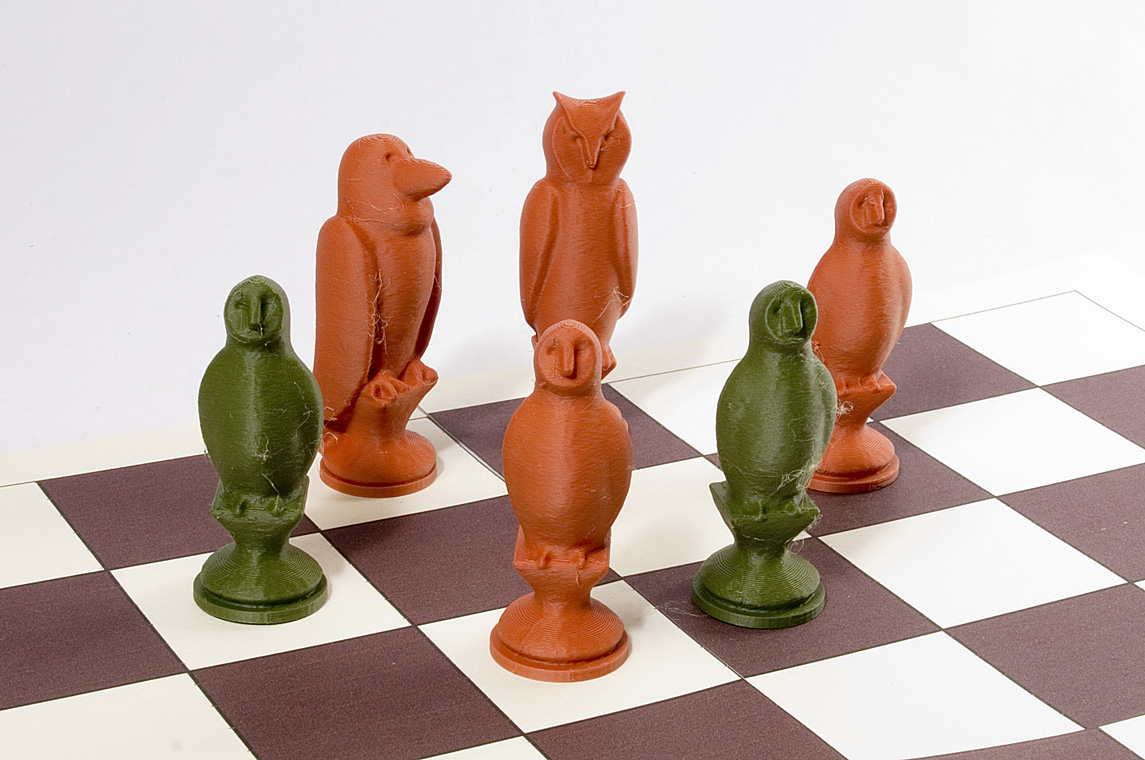
Like my earlier pawn, the new one was loosely based on a finch, a songbird with a conical beak that eats seeds and berries. It is standing on a small mound with its wings fluffed up in display. This does not describe a naturalistic behavior but it gives the piece its own identity.
The Rook
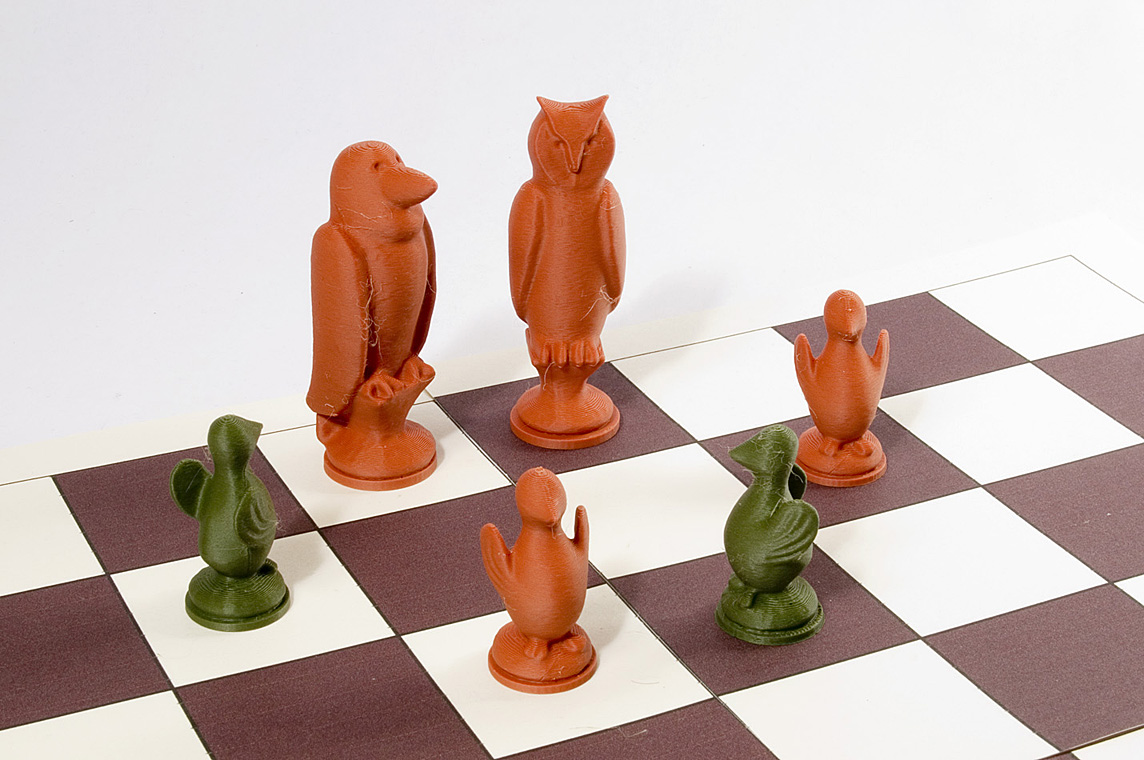
The original rook of Persian and Indian chessboards was a chariot, and later an elephant. The idea was that the piece would have a solid presence on the board, built like a tank with the capacity to carry a soldier. The pelican has a suitably capacious bill that fulfils the character image. It squats on a larger mound than the pawn.
The Knight
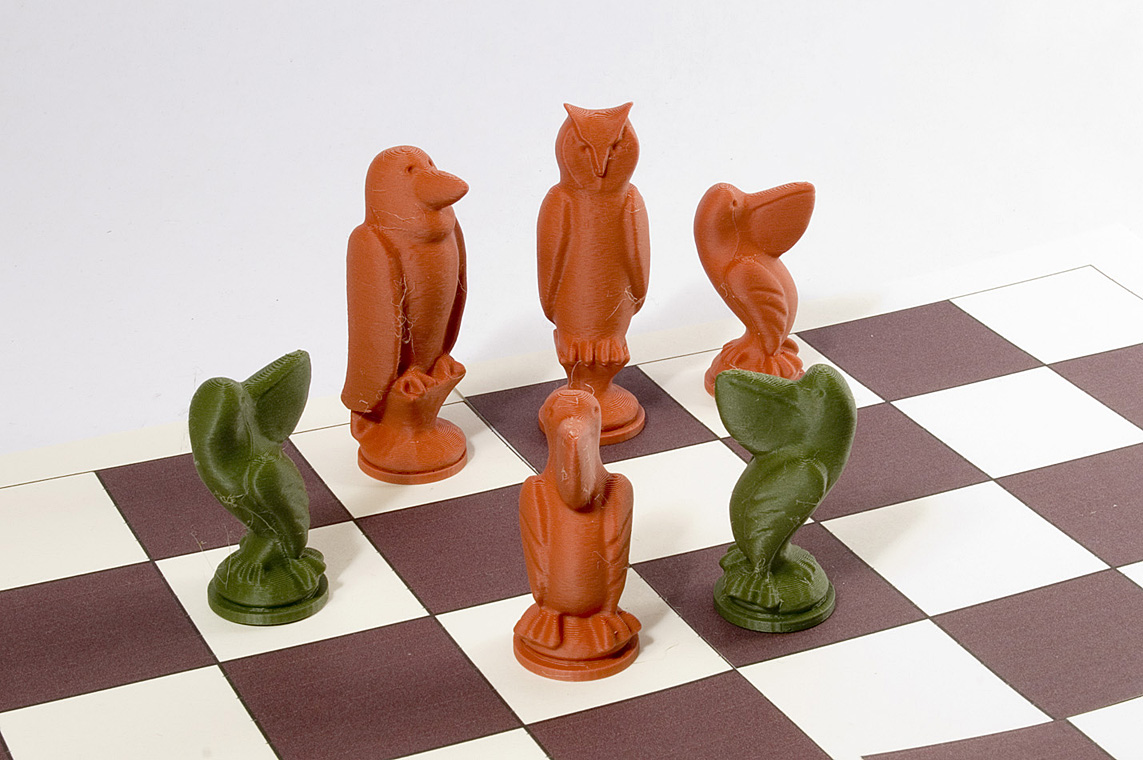
The knight is usually recognised as a horse's head, but in the Lewis chess set from Scotland the knight was a warrior on a horse or pony, not unlike the piece in the early Persian game of Shatranj. My first knight had held up its wings like scythes as a reminder of the 'jump' in the chess piece's move. The new knight has its wings stretched open to suggest its direction, not unlike a cormorant drying its wings. In common with the other major pieces here, the knight sits on a pedestal to elevate it above the front row.
The Bishop
The surreal bishop was derived from both the toucan and the hoopoe, but with a squat, fat body. This time I have drawn influence from the ground-dwelling kākāpō parrot. You might think of Orson Welles in his role as Cardinal Wolsey.
The Queen
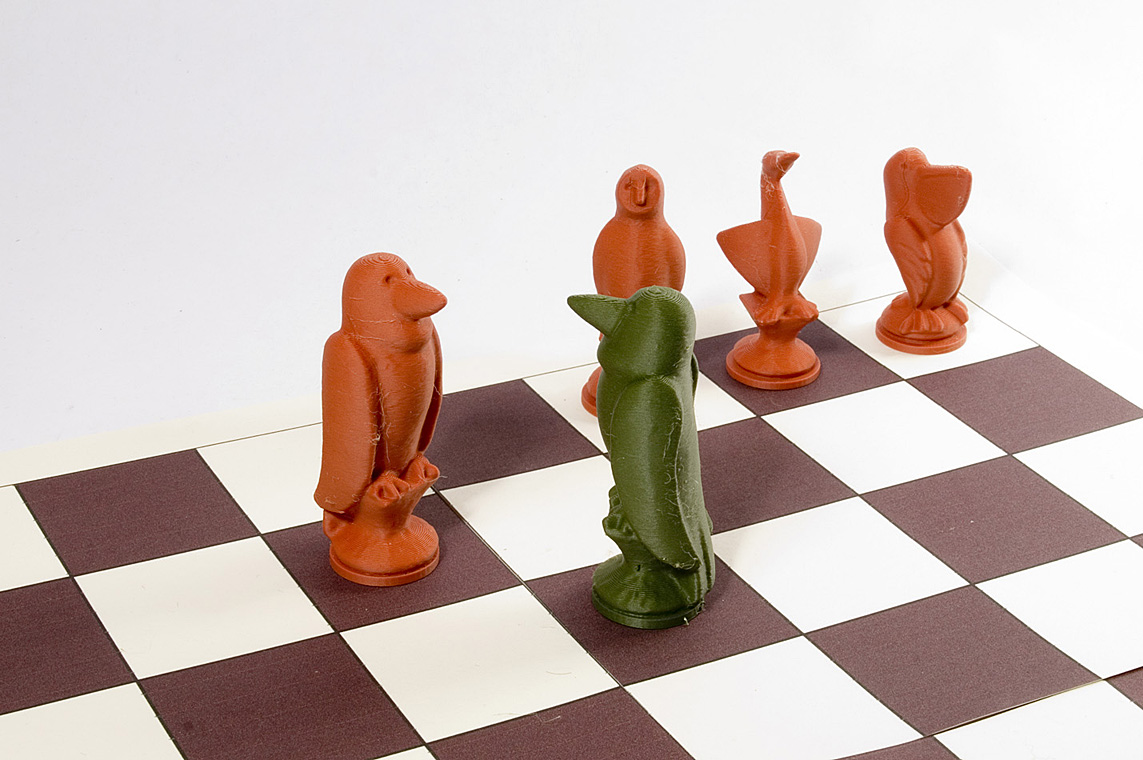
Corvids are recognised as the smartest of birds, good at problem solving and tool making. They show both analytical skills and empathy, perhaps appropriate for the strongest and most versatile piece on the board.
The King
Bubo bubo is the taxonomic name of the Eurasian eagle-owl, one of the larger birds of prey. In France, it is known as a Grand-duc d'Europe. I met one in the 1970s that had been shot but then rescued and cared for. It stood tall and proud in its cage as it waited to be fed. That Grand-duc was the source inspiration for all the abstract bird sculpture I made over the years.
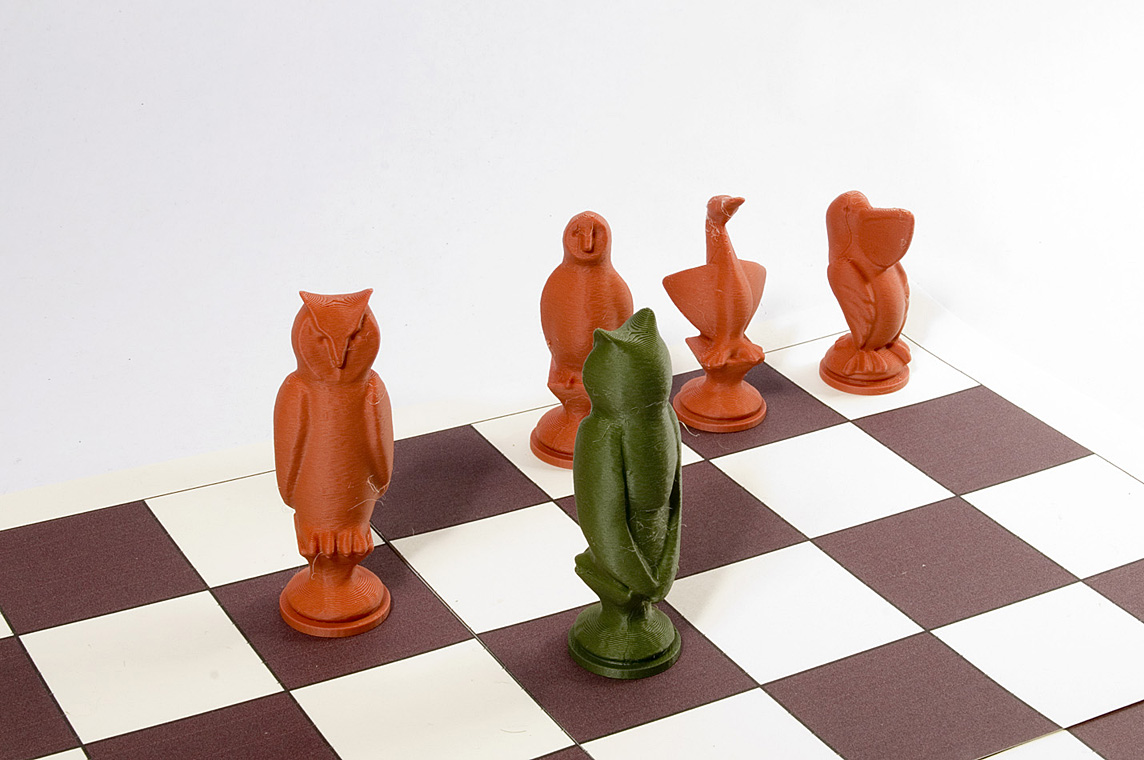
The proportions of the board are also important and it should be neither too large nor too cramped. 40-45mm square seems a good estimate for these pieces. I currently use printed sheets of heavy art paper.
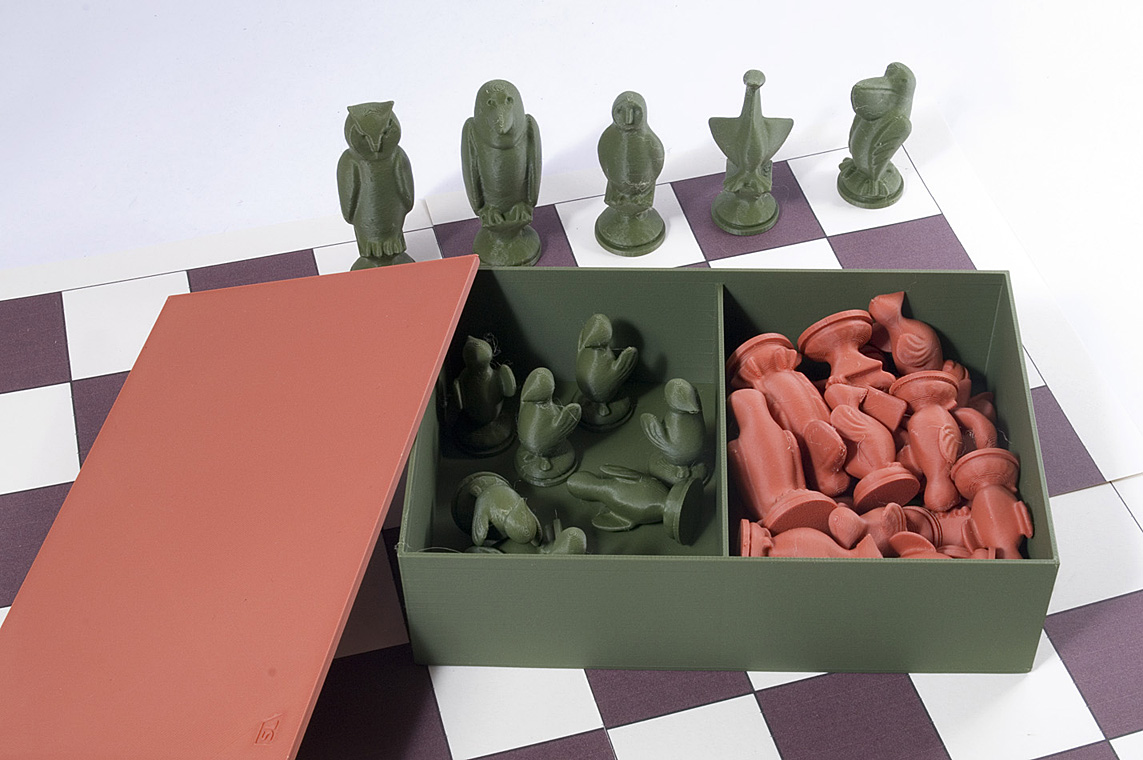
The 3D-printed 32-piece chess set of hypothetical birds in a box, costs £45, plus post and packing. You will need to have your own board. It is currently printed in Red Granite and White Marble or Matte Terracotta and Matte Green PLA (Polylactic acid). Other colours are available.
PLA is a thermoplastic polyester derived from renewable organic compounds. It can be recycled as it is not a fossil-fuel plastic.
You can contact me here for further details: sandehalynch AT yahoo DOT com
Postage is an extra £8 for Tracked 24 within Great Britain, or from £20 for International Tracked - (2026).